Hi, I’m Jennie Nash

I’m the founder and CEO of Author Accelerator.
I started this business after seeing how many writers struggled—not because they lacked talent, but because they lacked sustained, thoughtful support.
Editing wasn’t enough. Courses weren’t enough.
What was missing was someone who could stay with a writer through the entire process of creating a book.
That’s where book coaching began.
Since then, we’ve certified more than 450 book coaches who are now working with writers around the world—helping them build stronger books and find their way through the process of finishing them.
A New Way To Nurture Writers
For ten years, I taught a memoir course at UCLA Extension, and during that time I saw the same pattern again and again: writers who were thoughtful, committed, and deeply engaged in their work, but who struggled to make meaningful progress.
It was so frustrating to watch.
They were doing what they had been told to do. They showed up, they wrote, they revised. But the structure around them wasn’t designed to carry a project of this scale. A workshop could offer moments of insight, but it couldn’t hold the full weight of a book.
Again and again, writers would leave with pieces of something promising, but without a clear path forward.
At the same time, I had experienced a very different kind of process in my own work. I published six books with Big Five publishers and knew what it felt like to have close editorial engagement—work that was iterative, sustained, and focused on the book as a whole.
But as publishing became faster and less forgiving, it was clear that this kind of experience was becoming less and less available to most writers.
I found myself thinking about what a different model might look like—one that approached a book not as a series of isolated submissions, but as something that needed continuity, structure, and ongoing attention from start to finish.
The opportunity to try that came through a colleague at UCLA, Lisa Cron.
We worked together for more than a year as she developed what would become Wired for Story and Story Genius, moving from early ideas through a full manuscript, and then into a proposal and agent outreach.
That process felt different from anything I had done before. I felt more engaged and more responsive to the needs of the work as it evolved.
And it worked!
Lisa went on to secure a two-book deal with Ten Speed/Random House, and I came away with a much clearer understanding of what was possible.
That experience became the foundation for how I think about coaching writers—and, ultimately, the beginning of Author Accelerator.

Establishing the Gold Standard
As I refined this approach, I began working with more writers and saw what could happen when the process was handled this way.
Writers I worked with went on to publish widely—some reaching the New York Times and Wall Street Journal bestseller lists, others securing book deals with major publishers, or seeing their work expand into new forms, including TED Talks and television.
What mattered most to me, though, was not any single outcome, but the consistency of the results: writers producing stronger work, and finding a clearer path through the process of bringing a book into the world.
In 2013, I founded Author Accelerator to teach this method to others.
From the beginning, I was less interested in creating a loose network or a simple training program, and more interested in establishing a standard for the work itself—something that would require real skill, and that writers and industry professionals could trust.
That led to the development of a certification process designed to ensure that coaches were fully prepared before working with clients.
Over time, that standard has held.
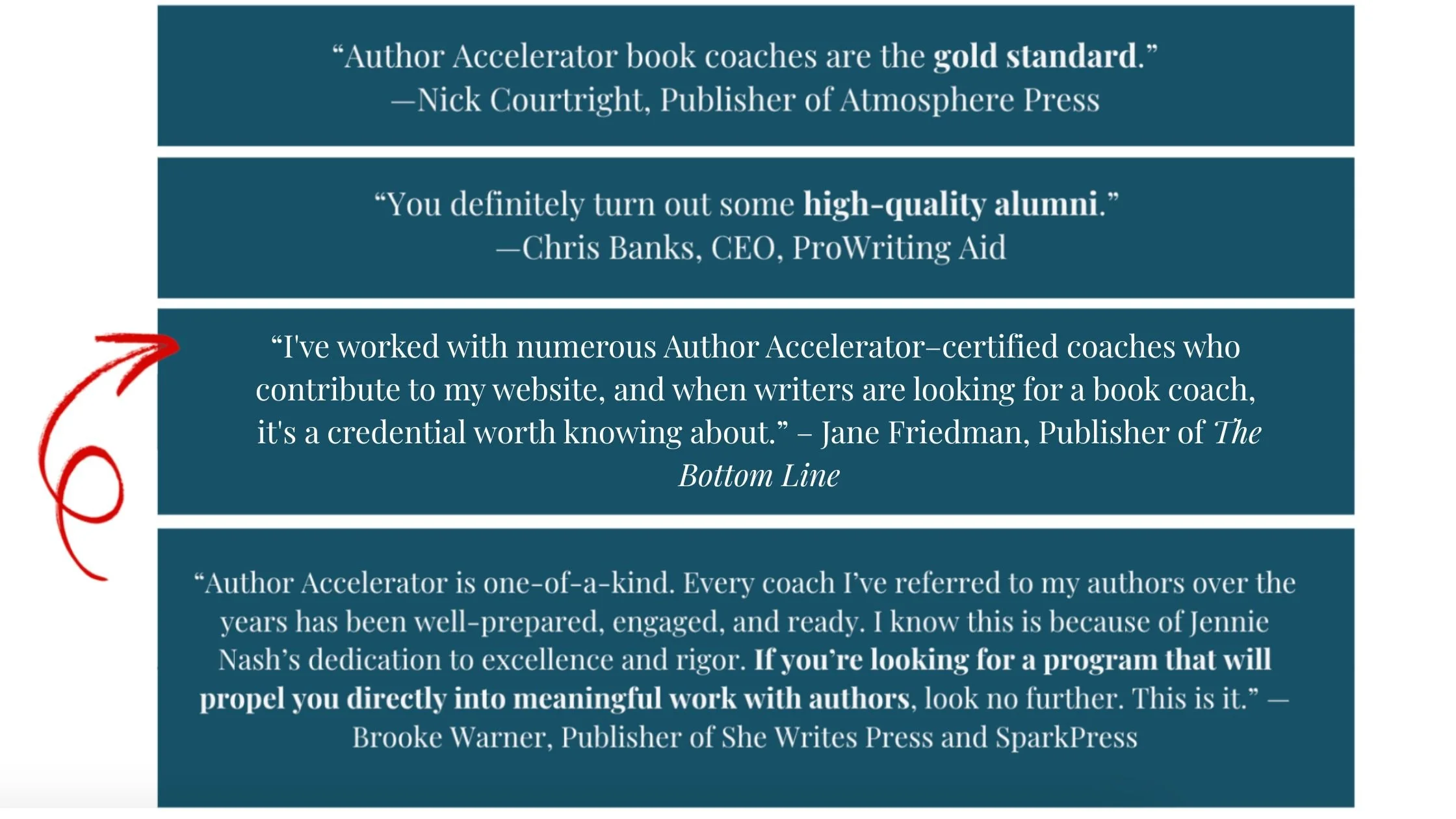
Author Accelerator coaches have built strong, sustainable practices, and the work has gained recognition across the publishing industry.
Meet the Book Coach Development Team
-
![]()
Stuart Wakefield | Team Lead
Stuart supports certification students as they prepare for practicum work, helping them build confidence, strengthen their thinking, and submit high-quality work. He’s known for a coaching style that is both thorough and compassionate, and for bringing warmth, insight, and calm to the certification experience. Alongside his student-facing work, Stuart also provides leadership within the team, helping to support consistency, quality, and thoughtful guidance across the programme. He is certified in both fiction and memoir and holds an MA with Distinction in Professional Writing. As well as writing fiction, he has also written for TV and the stage.
A little about STUART:Stuart is often the person helping certification students feel safe enough to stretch, grow, and rise to the challenge of practicum work. He combines a strong editorial eye with encouragement and care, and loves helping people find clarity in both their work and themselves.
- His favorite way to reset is taking a long bath.
- People are often surprised to learn that Stuart once played Elizabeth I’s lady-in-waiting in a play (and shaved his head for the role).
- Outside of work, he collects ThunderCats action figures.
- Stuart is happiest when developing characters for his writing.
- His ideal kind of day includes spending time with his dog.
- One thing that always makes Stuart laugh is the TV show Gimme, Gimme, Gimme.
- Stuart has a soft spot for books by Jilly Cooper.
- Nothing says “Stuart” more than eavesdropping on other people’s conversations.
- If Stuart is not working, you’ll probably find him watching a film. He used to work at Warner Bros., so his movie tastes are pleasingly wide-ranging.
-
![]()
Sara Gentry
Sara Gentry is a Math Ph.D. turned Author Accelerator triple-certified book coach. She helps the team nurture coaches-in-training, hosts community calls, and offers behind-the-scenes support.
A little about SARA:
- She is a homeschooling mom and worship director.
- In her own book coaching practice, Sara specializes in structure, cohesiveness, and commercial viability.
- Sara loves sports! She was a three-sport athlete in high school, played volleyball in college, coached high school varsity volleyball, and currently coaches youth soccer.
- She loves a good personality framework and enjoys learning what makes people tick.
- Sara loves merging with creative with the analytical. In college, she majored in both math and music. She continues to study piano with her college teacher.
-
![]()
Margaret McNellis
Margaret earned certification as a fiction book coach in April 2021, and began working for Author Accelerator six months later, initially helping to review certification applications. Since then, and along with the whole team, she’s helped shape the certification process. Margaret enjoys coaching students through the program and through their business objectives during and following certification; she lives for those “aha” moments coaches and writers alike experience through being coached. In addition to helping shepherd students through certification and launching/re-launching their book coaching businesses, Margaret assists Jennie in other work as well, including but not limited to Jennie's work as host of the #AmWriting podcast.
A little about MARGARET:
- She is lovingly obsessed with her corgi Beatrice.
- In what feels ike previous lives, Margaret was a scientist and a martial artist.
- When not helping guide coaches, Margaret enjoys working on her own fiction, poetry, and endeavors to unearth forgotten narratives from the past.
- Margaret believes that any bakery’s worth can be ascertained by the quality of their chocolate chip cookies (she once earned a ribbon of her own in a local fair for her own cookies).
- Margaret coaches writers on occasion, focusing on helping them get from spark to story in their literary, upmarket, and historical fiction stories.
- When not in the world of story or indulging in a chocolate chip cookie (or two), Margaret can often be found walking by the shore, staring out at the water Poldark-style, or painting a watercolor.
- Perhaps unsurprisingly, Margaret loves to geek out over historical dramas.
- Margaret’s favorite books of all time are Hamnet by Maggie O’Farrell and The Song of Achilles by Madeline Miller.
-
![]()
Sabrina Estudillo Butler
As a member of the Coach Development team, Sabrina loves helping coaches in training and recently certified coaches bridge the gap between knowledge and application. With an uncanny knack for seeing the unseen, Sabrina gives the kind of support that's both encouraging and challenging—just the right balance to help you grow. Sabrina is Author Accelerator certified in fiction and nonfiction. She has been a full-time book coach for over 4 years and freelance editor for 6 years inside her business, Unpolished Words.
A little about SABRINA:
- Before totally scaring her parents when she told them she was going to start an online business where she gets to read books all day and get paid for it, Sabrina was a licensed Architect for 7 years.
- Sabrina is a professional nap taker. She takes 90-minute naps (gotta get that full REM cycle!) multiple times a week, and she doesn’t even need an alarm to wake up.
- Her (professional) mission is to add more color to the bookshelves by supporting ambitious BIPOC authors write and publish amazing books.
- Sabrina’s (personal) mission is to accumulate 1,000 books so she can have a proper library.
- Sabrina is a Human Design projector, which means I really see and understand people on a deep level.



Seven Core Beliefs That Guide Our Work
1. I believe that the goal of writing books is not only about landing big publishing deals.
Those deals are nice when they come, but it’s not what makes writers write. Writers write because we are called to do it. We write to raise our voices. We write because making art of any kind often makes us feel alive. We write to have an impact on people, to engage readers, to get them to think and perhaps act. We write because it’s something we have dreamed about doing our entire lives and we can’t rest until we do it.
2. I believe that helping writers do this work—the work of their heart and their soul—is good, noble work.
Helping people get clarity around their thoughts, share their stories and perspectives, and invite others to see the world as they do is one of the ways we rise above the noise and reveal our humanity.
3. I believe that good writing can be taught.
There are rare native geniuses who know how to write an engaging book without having to work at it or think about it, but most writers must learn the craft. Throughout my career, I have had the pleasure of seeing all kinds of people from all kinds of educational and cultural backgrounds figure it out. It takes time and persistence, but it’s a skill that can be learned.
4. I believe that writing is not a zero-sum game.
Even if someone tries and fails (which means what? They don’t gain a broad readership? They don’t make the bestseller list? Insert any arbitrary metric….) the effort is still more than valuable and enriching. The same could be said for children who take piano lessons. The goal of the work is not always to end up playing at Carnegie Hall. It is a worthy goal to apply yourself to something challenging, to engage with an artistic medium, no matter the outcome. Aiming for big success is good — of course we all want it, and I get up every morning to try to guide clients to it — but it is not the only acceptable outcome.
5. I believe that it is difficult to make a living from writing alone.
Most writers will never get to quit their day jobs, land a movie deal with Reese Witherspoon, or even go on a great vacation from their earnings. It is for this reason that we don’t guarantee publication or a specific ROI from writing, and I counsel the coaches I teach not to do this, as well. Publishing is too dependent on luck and timing to make that kind of guarantee.
6. I believe that book coaching can be taught.
Whoever said that only successful writers can teach other writers to write? In my experience, famous writers are often the worst teachers because they are so genius at what they do that they can’t fathom not being a genius. They can explain what they do, but they can’t help others find their own way. There are a lot of good writers who are also good teachers, but the two things are not dependent on each other. In other industries — sports and music, for example, or executive business coaching — the coach has almost never reached the same level of achievement as the student. No one seems to question this. I believe it is no different in the world of writing. There are great agents and great editors at publishing houses who have never written or published a book. Most of them, in fact, have never written or published a book. They have learned how to help writers do their best work. This is what book coach training does for book coaches.
7. I believe that book coaching is a viable and meaningful way to build a professional life.
The coaches I have trained include teachers, writers, editors, librarians, copywriters, ghostwriters and others who are looking for work that is intellectually engaging, flexible, and sustainable—whether as a side practice or a full-time business.
Does Running a Book Coaching Business Sound Like A Dream Come True?
Watch Our Free Become a Book Coach Training to Learn More
More Ways to Learn About Book Coaching
Follow me on Substack
I write every week on The Art & Business of Book Coaching. Check out my Book Coaching 101 posts

What Exactly Is Book Coaching?
Learn more about book coaching and how book coaches are changing writers’ lives.

Feeling Imposter Syndrome?
Don’t let that stop you from doing work you love. Watch my video to hear why.

The Book On Book Coaching
Download Chapter 1 of my book on book coaching: Read Books All Day and Get Paid for It.